


For most drivers, yes, a lithium golf cart battery is worth it. You pay more up front, but you get a pack that lasts roughly two to three times longer than lead acid, charges faster, weighs far less, and needs almost no upkeep. Proper Lithium Battery Care can help maximize performance and extend the battery’s service life even further. Over the full life of the cart, lithium usually costs about the same or less than buying lead acid twice. If you only drive your cart a handful of times a year and want the lowest sticker price today, lead acid can still make sense. But if you ride often, climb hills, haul passengers, or want the cart to feel quicker and go farther on a charge, lithium is the clear pick. The longer warranties, the lack of watering and acid checks, and the steady power right down to a near-empty pack are what push most people to switch. Below, we break down lifespan, range, weight, charging, and the real lifetime cost so you can decide with confidence.
Why Are So Many Carts Switching to Lithium in 2026?
Lithium went from a premium upgrade to the default choice fast, and the reason is simple: people got tired of replacing lead acid every few years and dealing with the chores. A typical lead-acid pack asks you to check water levels, clean corrosion off the terminals, and watch how deeply you drain it. Skip those tasks, and the pack dies early. Lithium, specifically the lithium iron phosphate (LiFePO4) chemistry used in most carts today, asks for none of that. You plug it in and drive.
There’s also a performance gap that buyers notice the first time they test one. A lithium cart holds its speed up hills and on long runs because the voltage stays steady as the pack drains. A lead-acid cart slows down and feels tired as the charge drops. Once someone rides a lithium cart through the back nine or around a Virginia neighborhood without that fade, going back is a hard sell. That combination of less work and more usable power is what made lithium the standard people now expect.
It helps that prices have softened, too. A few years ago, the lithium premium felt steep enough that only the most committed drivers paid it. Cell costs have come down since then, more brands compete for your money, and the gap between a quality lithium pack and a fresh set of lead acid batteries keeps shrinking. When the price difference is smaller, and the benefits are this obvious, the math tips toward lithium for a much wider group of drivers than it did even three years ago.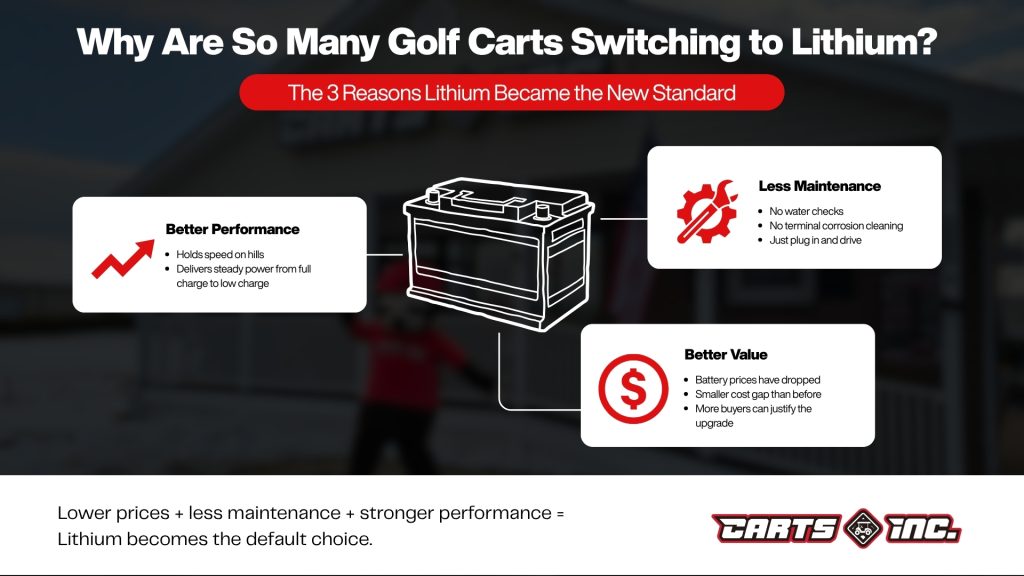
How Long Does a Lithium Golf Cart Battery Last vs Lead Acid?
A lithium golf cart battery typically lasts far longer than lead acid, and the gap is large. Most quality LiFePO4 packs are rated for somewhere in the range of 2,000 to 5,000 charge cycles, while flooded lead acid batteries usually deliver around 500 to 1,000 cycles before capacity drops off. In everyday terms, lead acid often needs replacing every three to five years, and a good lithium pack can run ten years or more with normal use.
The difference comes down to how each chemistry handles being drained. With a lithium vs lead acid cart comparison, lead acid hates deep discharges. Pull it down past about half its capacity regularly, and you shorten its life. Lithium can be drained much deeper, often to 80 percent or more, without the same penalty. That means you actually use more of the energy you paid for, and you do it without grinding the pack down.
Cycle counts are not the whole story, though. A charge cycle means one full discharge and recharge, so two half-day rides that each use 40 percent of the pack roughly add up to less than one cycle. A weekend driver who rides Saturday and Sunday might log only 60 or 70 cycles a year, which stretches a 3,000-cycle pack across decades on paper. The practical limit usually becomes calendar age and storage habits rather than raw cycle wear. Part of why we talk in years rather than cycles when we help someone plan a purchase.
What affects golf cart battery life the most
A few habits decide how long any pack survives. Heat is the big one. Storing a cart in a hot shed through a humid Virginia summer stresses any battery, though lithium tolerates it better than lead acid. Deep, repeated draining hurts lead acid badly and lithium far less. With lead acid, letting the water run low and skipping terminal cleaning quietly kills the pack. With lithium, the built-in battery management system handles most of the protective work for you, which is a big reason its real-world golf cart battery life runs so much longer.
Storage state of charge matters more than people expect. Leaving a lead-acid pack sitting empty for weeks lets sulfate harden on the plates, and that damage rarely fully reverses. Lithium dislikes long storage at a full 100 percent or at a dead-flat zero, so parking it somewhere around half to two-thirds charged before a long off-season is the gentlest choice. A simple monthly top-off check, even on a cart you barely touch in winter, pays you back in capacity the following spring.
Range, Weight, and Charging: Where Lithium Pulls Ahead
Lithium wins on all three. It gives you more usable range per charge, it weighs a fraction of lead acid, and it recharges in a fraction of the time. These three advantages are the ones drivers feel every single day, not just on paper.
More usable range
A lithium pack delivers steady voltage almost until it’s empty, so the cart keeps its speed and pulling power through the whole ride. Lead acid voltage sags as it drains, which is why the last stretch of a long lead acid run feels slow. Because you can also safely use far more of a lithium pack’s rated capacity, you get noticeably more real distance out of the same nameplate amp-hours. For longer rides around a course, a campground, or a Virginia lake community, that extra dependable range matters.
A lot less weight
This is one of the biggest surprises for first-time buyers. A set of lead-acid batteries can weigh several hundred pounds, often in the 300 to 400-pound range for a full pack. A comparable lithium setup commonly weighs less than half that. Dropping that much weight makes the cart faster, easier on tires and brakes, and gentler on the motor and suspension. It also helps a little with grip on soft or wet ground, which is handy after a Virginia rainstorm. Lighter packs also make towing and loading the cart onto a trailer far less of a struggle.
Faster charging
Lithium charges quicker and can take a partial top-off without harm. Lead acid wants a slow, full charge and dislikes being left part-charged. With lithium, you can plug in for an hour at lunch, grab some range, and unplug without worrying about damage. There’s also no “memory” penalty for partial charges. For anyone who uses the cart throughout the day, that flexibility changes how the cart fits into your routine.
Here is a side-by-side look at how the two chemistries stack up:
| Factor | Lithium (LiFePO4) | Flooded Lead Acid |
| Typical lifespan | 10+ years | 3 to 5 years |
| Charge cycles | 2,000 to 5,000 | 500 to 1,000 |
| Usable capacity | 80 percent or more | Around 50 percent |
| Full pack weight | Roughly half of the lead acid | 300 to 400 pounds |
| Routine upkeep | Almost none | Watering, terminal cleaning |
| Partial charging | Fine, no penalty | Disliked, shortens life |
| Voltage under load | Steady until near empty | Sags as it drains |
Upfront vs Lifetime Cost: The Real Math
Lithium costs more on day one and often costs the same or less over the life of the cart. That’s the honest summary. A lithium pack carries a higher sticker price than a lead acid set, sometimes a good deal higher. The flip happens when you count how many times you’d replace lead acid in the same span.
Here’s the logic without invented numbers. If lead acid lasts roughly three to five years and lithium lasts ten or more, you may buy lead acid two or three times to match the life of a single lithium pack. Add the cost of replacement labor each time, plus the water, terminal cleaner, and the odd corroded connector you swap along the way. Lithium also wastes less energy as heat during charging, so you put slightly less on your power bill over the years. Stack those savings against the higher entry price, and lithium usually breaks even, then comes out ahead.
There’s a comfort factor, too, that doesn’t show up on a spreadsheet. No watering, no acid checks, no scrubbing white crust off terminals, and longer warranties on most quality lithium packs. If you value not thinking about your batteries, that peace of mind has real worth. The drivers who still pick lead acid are usually the ones who barely use their cart and want the lowest possible price right now, and that’s a fair choice for that use case.
Resale value is the quiet bonus most people forget. A used cart that already runs a healthy lithium pack with years of warranty left commands a stronger price than the same cart sitting on an aging lead acid that a buyer knows they’ll have to replace soon. If you ever sell or trade up, some of that lithium premium comes back to you at the curb. That’s one more reason the lifetime math leans the way it does.
Can You Convert an Older Cart to Lithium?
Yes, you can convert most older carts to lithium, and it’s one of the most popular upgrades we see. A lithium conversion swaps your old lead-acid pack for a lithium one, and on many carts, it’s a fairly direct job. The new pack’s lighter weight is a bonus your older frame, motor, and brakes will appreciate.
A few things decide how smoothly the swap goes. First, the charger. Lead acid chargers use a different charging profile, so a proper lithium conversion usually means a matching lithium charger or a charger that supports the right profile. Using the wrong charger can shorten the new pack’s life or trip its protection system.
Second, voltage and fit. The pack has to match your cart’s system voltage, and because lithium is so much lighter, you sometimes need spacers or trays so it sits securely where the heavy old batteries used to brace themselves. Third, the battery management system. Quality lithium packs include one that guards against over-charge, over-discharge, and heat, and you want that protection in place rather than skipped to save money.
For an older cart that still has a healthy motor and controller, converting is often smarter than buying a whole new cart. You keep the body and frame you already like and modernize the part that was holding it back. If your controller is very old, it’s worth a quick check to confirm it plays nicely with the new pack before you buy.
Is a conversion worth it on a high-mileage cart?
It depends on the rest of the cart. If the motor, controller, and frame are solid, a lithium conversion can give a tired cart a second life for far less than a replacement. If the cart already has motor or controller trouble, fix or price those first, because a fresh battery won’t cover for worn-out drivetrain parts. When the bones are good, the upgrade pays you back in range, speed, and years of low-maintenance driving.
The Long-Term Math for Virginia Owners
For most Virginia owners who keep a cart for several years, the longer service life is what tips the math toward lithium. A single lithium pack can outlast two or even three sets of lead-acid batteries, so even though it costs more on day one, the cost spread across the years you own the cart often comes out lower. If you plan to sell soon, the savings matter less, but for a long-term owner, they add up.
A Quick Word Before You Buy
We’re Carts In CVA, and we help Virginia drivers sort out exactly these questions every week, from picking the right pack to handling a clean conversion. If you want a straight answer on whether lithium fits your cart and how you ride, reach out through Carts In CVA, and we’ll point you in the right way.
Frequently Asked Questions
For most regular drivers, yes. The higher upfront cost is usually offset over time because lithium lasts two to three times longer than lead acid, needs no watering or terminal upkeep, and charges faster. If you rarely use your cart and want the cheapest option today, lead acid can still make sense.
Most quality LiFePO4 packs are rated for roughly 2,000 to 5,000 charge cycles, which often works out to ten years or more of normal use. By comparison, lead acid usually lasts about three to five years, or around 500 to 1,000 cycles.
They give you a more usable range and steadier speed. Lithium holds its voltage almost until empty, so the cart keeps its pulling power through the whole ride, while lead acid slows down as it drains. Lithium is also much lighter, which helps acceleration and handling.
In most cases, yes. A lithium conversion fits many older carts directly, though you’ll typically need a lithium-compatible charger, the correct system voltage, and sometimes trays or spacers because the new pack is so much lighter. A healthy motor and controller make the upgrade worthwhile.
Almost none. There’s no water to add, no acid levels to check, and no terminal corrosion to scrub. A built-in battery management system handles charge protection automatically. Just keep the pack reasonably cool and avoid leaving it fully drained for long periods.