


A standard golf cart is not street legal across Virginia by default. The state lets towns and counties decide if golf carts can use certain public roads, and only then under a local ordinance. So whether you can drive yours on the street depends a lot on where you live. The question of a golf cart’s street legal status in Virginia really comes down to two things: the type of cart you own and the rules in your specific town.
There is one big exception. A low-speed vehicle, often called an LSV, is treated differently. If it meets federal equipment standards and you title and register it with the DMV, an LSV can be driven on roads posted at 35 mph or less statewide. A plain golf cart cannot. When shopping for options, buyers can also explore New Inventory from local dealers to find street-ready models, upgraded carts, and LSV options that meet Virginia requirements.
A good way to think about it: the state sets a floor, and your town builds on top of it. The floor says LSVs get broad road access, and plain golf carts get none unless a local rule grants it. What your town adds on top is what decides your day-to-day driving. That two-layer setup explains almost every confusing situation Virginia cart owners run into.
What Counts as Street Legal When Your Cart Looks Like Everyone Else’s?
The label on your cart matters more than how it looks in the driveway. Virginia law splits these small vehicles into a few buckets, and each one has its own path to the pavement.
A golf cart is built mainly for use on a golf course. The state defines it as a vehicle with a top speed of roughly 15 mph or less. On its own, it has no automatic right to public roads.
A low-speed vehicle (LSV) is a four-wheeled machine that can go faster than 20 mph but not more than 25 mph. To sell one as an LSV, the maker has to include real safety gear from the factory. This is the category most people mean when they say “street legal cart.”
A neighborhood electric vehicle, the NEV that Virginia drivers ask about, is essentially an electric LSV. The terms get used loosely, but the legal treatment lines up with the low-speed vehicle rules. If it is titled and registered as an LSV, it can travel on the same lower-speed roads.
Knowing which bucket your vehicle falls into is the first real step. A cart that tops out at 14 mph will never qualify as an LSV, no matter what you add to it. Speed is the dividing line the state cares about most, because a vehicle that cannot reach roughly 20 mph cannot keep pace with even slow neighborhood traffic. That is why a “speed-limited” golf cart, one with dealer software caps below 20 mph, stays a golf cart in the eyes of the law even if it carries lights and belts.
There is also a gray-area vehicle worth naming: the lifted, decked-out cart you see at the beach with a stereo and big tires. Cosmetics do not change the category. If its top speed sits at 15 mph and it lacks a factory VIN, it is still a standard golf cart, no matter how much it costs. Buyers sometimes assume a pricey, fully loaded cart must be road-legal. The paperwork and speed rating, not the price tag or the extras, decide that.
LSV vs Standard Golf Cart: Which One Can Actually Hit the Road?
The short version: an LSV can be made fully street legal in Virginia, and a standard golf cart usually cannot, except where a local ordinance allows limited cart use.
Here is how the two compare in plain terms.
| Feature | Standard Golf Cart | Low-Speed Vehicle (LSV) |
| Top speed | About 15 mph or less | Between 20 and 25 mph |
| Statewide road rights | None | Roads posted 35 mph or less |
| Local ordinance needed | Yes, for any road use | No |
| DMV title and registration | Not available | Required |
| Factory safety equipment | Usually missing | Included |
| Insurance | Not applicable | Required |
| Crossing a faster road | Only where a town allows | Allowed at intersections |
The thinking behind the LSV laws Virginia uses is simple. Once a vehicle is fast enough to keep up with slow traffic and carries proper lights, mirrors, and belts, the state treats it more like a real car. That is why the registration and equipment bar is higher for an LSV, and why it earns broader road access in return.
If you want to drive on public streets regularly and not just inside a gated community, an LSV is almost always the right choice. A standard cart will keep you tied to whatever your local rules permit. Cost is the trade-off worth weighing. An LSV carries a higher sticker price, plus title fees, plates, and an insurance premium each year. A standard cart skips all of that but buys you far less freedom. The right pick depends on whether you mostly drive inside a community or want to run real errands on town roads.
Where Can You Legally Drive a Golf Cart on Virginia Roads?
Where you can drive depends on the road’s speed limit and your town’s ordinance. There is no single statewide green light for golf carts.
For an LSV, the rule is steadier. You can use any public road posted at 35 mph or less. You can also cross an intersection where a faster road meets a slower one. You cannot cruise down a 45 mph highway or use limited-access roads.
For a standard golf cart, access is narrower and more local. Virginia gives counties, cities, and towns the power to permit golf carts on designated public roads. When a locality does this, it usually:
- Picks specific streets or zones where carts are allowed
- Caps the road speed limit, commonly at 25 or 35 mph
- May require crossing points where carts move between cart-friendly areas
- Can add rules about hours, lighting, or operator age
Some Virginia Beach towns and planned communities have welcomed cart traffic and posted signs to match. Other towns have no ordinance at all, which means carts stay off the road there. Two neighboring localities can have opposite rules, so the street that is fine in one town may be off limits a few miles away.
This patchwork is exactly why checking before you drive saves headaches. A cart that is welcome on a coastal main street might earn a ticket in the next county over. A few real-world patterns show up again and again. Beach and resort towns tend to write generous ordinances because car traffic fits the local pace. Lake communities often allow carts on quiet residential loops but keep them off the main connector road. Rural counties frequently have nothing on the books at all, so a standard cart there has no legal road use, no matter how empty the road looks.
One more point trips people up: a private community road inside a gated neighborhood is not a public road, so the homeowners’ association sets its own rules there. That is why you can drive a plain cart freely inside many planned communities, even though the same cart would be illegal the moment it crossed onto a public street outside the gate.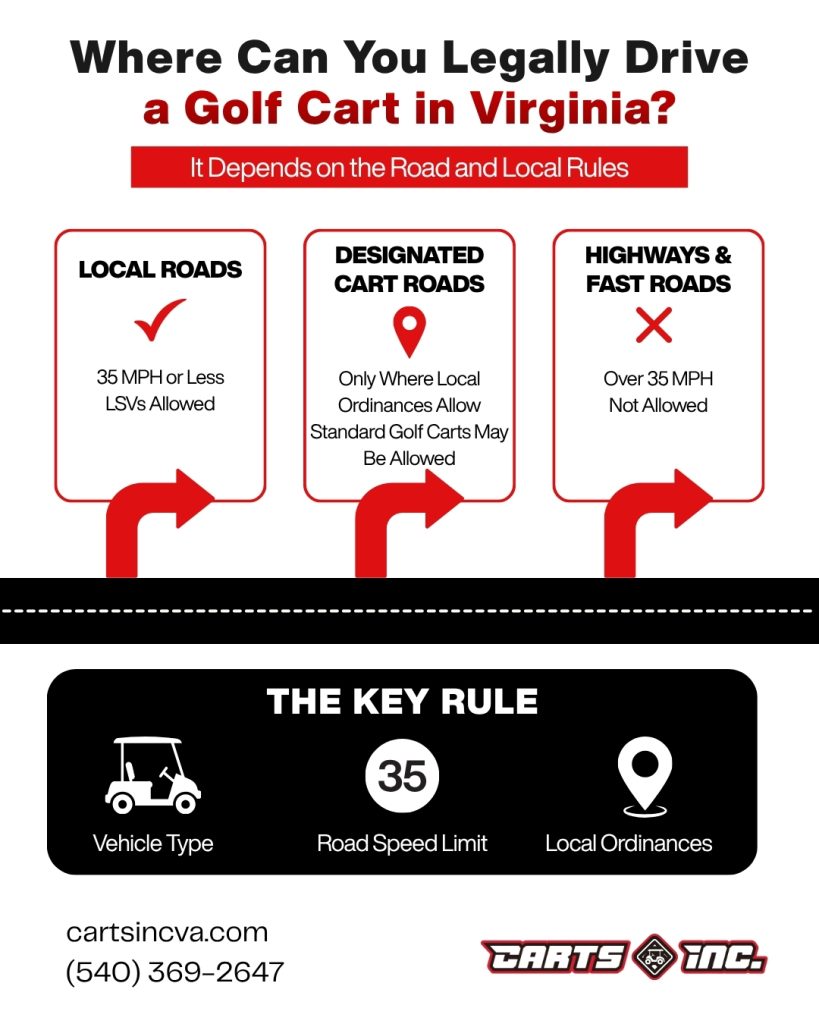
Golf Cart Registration in VA and the Equipment You Need
For an LSV, registration is required, and the vehicle must carry specific safety gear. For a standard golf cart, registration is generally not available, which is part of why road use stays so limited.
When it comes to golf cart registration, VA owners should know the LSV path looks a lot like registering a small car. To title and register an LSV with the DMV, you typically need:
- Proof of ownership, such as a manufacturer’s certificate of origin or a title
- A 17-character vehicle identification number (VIN)
- Proof of insurance that meets state minimums
- The completed title and registration application, and applicable fees
Once registered, your LSV gets a license plate and must stay insured like any other vehicle. Plan for a trip to the DMV with the documents in hand, since the VIN often needs to be verified in person. Budget a little extra time if you bought the cart used, because a missing or unclear title is the most common reason an LSV registration stalls.
The equipment side is just as important. A factory-built LSV already includes the required features, but it helps to know what they are:
- Headlights, tail lights, and brake lights
- Turn signals
- Reflectors front and rear
- Rear-view mirrors, often one inside and one on the driver’s side
- A windshield
- A parking brake
- Seat belts for every seat
- A VIN
A standard golf cart usually lacks several of these from the factory. Even if your town allows carts on certain roads, the ordinance may still require lights, reflectors, or slow-moving vehicle signage. Always read the local rules so your cart matches what they ask for. One caution worth stating plainly: bolting headlights, belts, and mirrors onto a 15 mph golf cart does not turn it into a registrable LSV. The DMV will not register a vehicle that cannot meet the 20-to-25 mph speed rating and was not built to the federal LSV standard. Aftermarket gear can satisfy a town ordinance, but it cannot reclassify the vehicle.
Why You Should Always Check Your Town’s Ordinance First
Because Virginia hands the decision to local governments, your town’s ordinance is the final word for standard golf carts. State law sets the frame, but the town fills in the details that decide whether you can legally roll down your street.
A quick check protects you in a few ways:
- It confirms if carts are allowed at all: Many towns have no ordinance, which means no road use for standard carts.
- It tells you which roads count: Allowed streets are often listed by name or by speed limit.
- It spells out equipment rules: Some towns require lights and signage even for short trips.
- It covers operators: A few localities set a minimum driver age or require a valid license.
- It lists penalties: Driving where carts are banned can bring fines.
You can usually find the rules on your town or county website, or by calling the local government office or police non-emergency line. It takes a few minutes and removes the guesswork. When you call, ask three direct questions: which roads carts may use, what equipment the town requires, and whether the driver needs a license. Those three answers cover most of what a ticket would be written for.
Rules also change. A town that had no cart ordinance last year might add one, and limits can be adjusted. Checking each season, especially before summer when cart use peaks in Virginia’s coastal and lake communities, keeps you current.
If you are buying a cart specifically to drive on the street, the smartest move is to match the vehicle to your goal. Want freedom to use public roads broadly? Choose a titled, registered LSV. Only driving inside a community that allows carts? A standard cart with the right add-ons may be enough. Either way, confirm the local rules before you spend.
Where You Can Actually Drive One
Keep in mind that where you can legally drive a cart varies by town. Virginia lets local governments approve golf carts on streets posted at 25 miles per hour or less, and many beach and lake communities have passed those ordinances, while other areas have not. Before you buy, check your own town’s rules so you know exactly which roads are open to you and whether you need to cross any faster roads to get where you are going.
Ready to Find the Right Street-ready Ride?
Picking between a standard cart and a true LSV is easier when you can see your options side by side. At Carts Inc, we help Virginia drivers match a cart to how and where they plan to drive, including LSV models built to meet the equipment and registration rules covered above. Take a look at what fits your neighborhood and your road plans.
Frequently Asked Questions
A standard golf cart is not automatically street legal in Virginia. It can only use public roads where a local ordinance specifically allows it. A low-speed vehicle (LSV), by contrast, can be driven statewide on roads posted at 35 mph or less once it is titled and registered with the DMV.
A golf cart tops out around 15 mph and is built for course use, with no built-in road rights. An LSV travels between 20 and 25 mph, comes with required safety equipment from the factory, and must be registered. That registration and gear let an LSV use lower-speed public roads that a standard cart cannot.
Standard golf carts generally cannot be registered with the DMV, which limits them to roads that your town specifically permits. An LSV must be titled, registered, insured, and plated, much like a small car. If you want a cart you can drive on public roads broadly, the LSV registration path is the one to follow.
An LSV can travel on any public road posted at 35 mph or less. It can also cross an intersection where a higher-speed road meets a lower-speed one. It cannot be driven on highways or limited-access roads, and it cannot use roads posted above 35 mph.
A street-legal LSV needs headlights, taillights, brake lights, turn signals, reflectors, mirrors, a windshield, a parking brake, seat belts for each seat, and a VIN. Factory-built LSVs include these. Even a standard cart allowed on local roads may need lights, reflectors, or slow-moving vehicle signage under town rules.