


For most buyers, an electric cart is the better pick. When you weigh up the gas vs electric golf cart question, electric wins on day-to-day cost, quiet operation, and far simpler upkeep. There is no oil to change, no spark plugs to swap, and nothing to refill at the pump. You plug it in overnight, and it is ready by morning, which suits most neighborhood driving, short errands, and rounds on the course. Choosing a new golf cart with an electric setup can be a smart investment for owners who want reliable performance with less maintenance and lower running costs.
Gas still has a place. If you tow heavy loads, drive long distances between charges, or use your cart on a large rural property far from an outlet, a gas model can make sense. But for the typical Virginia owner running a few miles a day on paved streets and trails, electric is the easier, cheaper, and friendlier choice. The rest of this guide breaks down each factor so you can match a cart to how you actually drive.
Why Does This Choice Trip Up So Many Buyers?
The two carts look almost identical in the showroom, yet they behave very differently once you own them. People often pick based on a single feature they heard about, like top speed or refuel time, then regret it later when the real costs and habits sink in. The smart move is to think about your weekly routine first, then let that pick the powertrain.
Ask yourself a few quick questions. How far do you drive between stops? Do you have a garage outlet or a covered spot to charge? Are you hauling tools, coolers, and passengers up steep grades, or just cruising flat streets? Your honest answers point clearly toward one option. Below, we walk through the five factors that matter most.
It also helps to think past the first year. A cart is a five-to-ten-year purchase, and the habits it forces on you add up over that span. A gas owner pumps fuel and changes oil dozens of times across a decade. An electric owner plugs in a cord and, every several years, swaps a battery pack. Neither routine is hard, but they feel very different in practice, and the one that grates on you is the one you will end up resenting. Picture the whole ownership stretch, not just the drive home from the dealer.
Which Costs Less to Run, Gas or Electric?
Electric is cheaper to run for almost everyone. The golf cart running cost gap is the single biggest reason buyers switch. Charging an electric cart from empty costs a small fraction of what a tank of gas costs, and electricity prices stay far steadier than pump prices throughout the year.
Here is the rough picture. An electric cart pulls a few kilowatt-hours to fully charge, which usually costs around a dollar or two, depending on your local rate. A gas cart burns through a gallon or more for similar driving, and gas prices swing with the season. Over a year of regular use, those small daily differences add up to real money. If you drive a few miles every day, the gap between a couple of dollars a week in electricity and a tank of gas every week or two can reach a few hundred dollars across a single season.
There is a catch worth being honest about. Electric carts use a battery pack that eventually needs replacement. Lead-acid packs often last several years, and lithium packs commonly last much longer, sometimes the life of the cart. When that pack does need swapping, it is a larger one-time bill. Gas carts spread their costs out in smaller, more frequent chunks at the pump and the shop. Even counting an eventual battery swap, most owners spend less overall going electric, especially with lithium.
It helps to picture the two cost shapes side by side. Here is a rough comparison of where the money goes:
| Cost factor | Electric cart | Gas cart |
| Daily energy | A dollar or two per full charge | A gallon or more of gas per fill |
| Routine upkeep | Tires, brakes, and an occasional battery water | Oil, filters, plugs, fuel system |
| Big one-time cost | Battery pack every several years | Engine repair, if neglected |
| Price stability | Steady electric rates | Swings with seasonal gas prices |
The pattern is clear. Gas drips money out in small, frequent amounts that are easy to overlook until you tally a year of receipts. Electric front-loads almost nothing and saves the one real expense for a battery swap years down the road. For a budget you can predict, electric is the calmer choice, and the running-cost savings often pay back the difference long before that battery ever needs attention.
How Much Maintenance Does Each One Need?
Electric carts need much less maintenance, and that is a major part of the electric golf cart benefits story. An electric motor has very few moving parts. There is no engine oil, no oil filter, no air filter, no spark plugs, no fuel filter, and no belts that wear as a gas engine has. Most owners just keep the tires aired up, check the brakes, and, if they run lead-acid batteries, top off the water in the cells now and then.
A gas golf cart is closer to a small lawn mower or motorcycle in upkeep. You change the oil, replace filters and plugs, and keep an eye on the fuel system. None of that is hard, but it is regular work, and skipping it shortens the engine’s life. If you enjoy tinkering, that may not bother you. If you want a vehicle you can mostly ignore between drives, electric is the relaxed choice.
One more point on the electric side. Fewer parts mean fewer things that can strand you. There is no carburetor to gum up if the cart sits all winter, which matters in Virginia, where carts often hibernate through the cold months. A quiet charge, and you are rolling again in spring.
To make the contrast concrete, here is what a year of upkeep tends to look like for each. A gas owner changes the oil once or twice a season, swaps the spark plug and air filter on a schedule, adds fuel stabilizer before winter storage, and watches for fuel-line cracks or a fouled carburetor. An electric owner with a lithium pack mostly checks tire pressure, tests the brakes, wipes down the terminals, and plugs in. An electric owner on a lead-acid battery adds one chore: checking the water level in each cell every month or two and topping off with distilled water. That single task is the closest electric gets to the gas routine, and it disappears entirely if you move to lithium. Spread across a decade, the gas owner racks up dozens of small service jobs while the electric owner handles a handful.
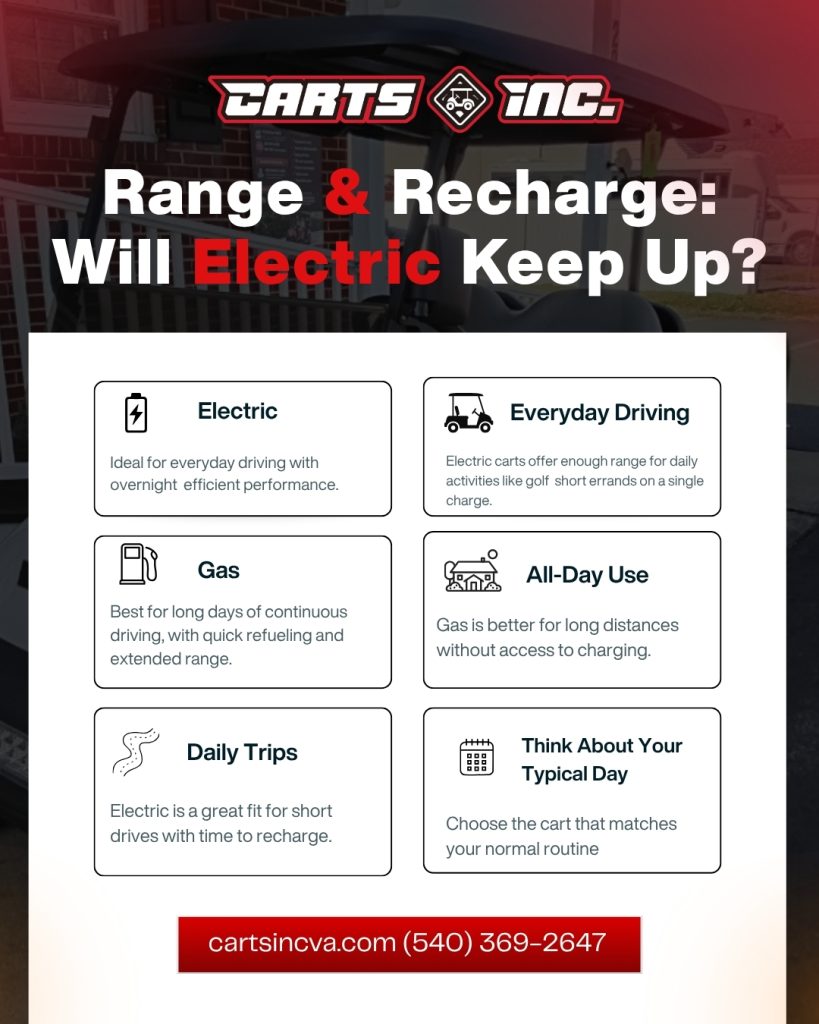
Range and Recharge: Will Electric Keep Up?
For everyday driving, yes, electric keeps up easily. A healthy electric cart covers a solid distance on one charge, plenty for a round of golf, a loop around the neighborhood, or running errands across a community. The honest tradeoff is recharge time. When the battery runs low, you plug in and wait. Lead-acid packs often need several hours to a full overnight charge, while many lithium packs charge faster.
Gas wins on pure range and turnaround. When a gas cart runs low, you pour in more fuel and keep going for minutes, the same as a car. For someone covering long miles all day with no chance to plug in, that quick refuel is a real advantage.
So the question is really about your pattern. If you drive in bursts with downtime in between, like most owners do, electric range is more than enough, and overnight charging is invisible to you. If you run a cart hard for hours across a big property with no break, gas may suit you better. Match the cart to your longest typical day, not to a worst-case day that rarely happens.
A practical way to size your needs is to add up a normal day’s loop. A round of golf plus the ride to and from the clubhouse rarely strains a healthy pack. A few neighborhood errands, a trip to the mailbox cluster, and an evening cruise still leave charge to spare.
The cart spends the night on the charger and greets you fully in the morning. The only time the math gets tight is the all-day, no-outlet scenario, and that is exactly where gas earns its place. Be honest about how often that day actually shows up. For most owners, it is a handful of times a year, if that, and renting or borrowing for those rare stretches costs far less than living with a gas engine year-round.
How Big Is the Noise and Emissions Difference?
The difference is night and day. An electric cart runs nearly silently. You hear the tires and the breeze, not an engine. That quiet makes early-morning golf rounds and evening cruises through a quiet neighborhood far more pleasant, and your neighbors will thank you. There are no exhaust fumes either, so you can park and charge inside a closed garage without worrying about ventilation.
A gas cart has a small combustion engine, so it makes engine noise and produces exhaust like any gas-powered machine. It is not loud like a truck, but you and everyone nearby will hear it, and you would not want to run it in an enclosed space. For some buyers, the engine note is part of the appeal. For most, the quiet, clean feel of electric is one of its best everyday perks.
This factor matters more in Virginia communities with shared streets, golf-cart-friendly paths, and homeowner rules. Many neighborhoods lean toward quiet, low-emission vehicles, and an electric cart fits right in without ruffling anyone. Some homeowner associations even spell out noise limits or restrict gas engines on shared paths, so an electric cart can save you a headache with the board. The clean side matters too. No fumes means you can charge in an attached garage, and you are not breathing exhaust while you load groceries or wait for a passenger. On a still summer evening, the quiet hum of an electric cart simply fits the setting better than an idling engine does.
When Does Gas Still Make Sense?
Gas makes sense for heavy, far, and off-grid use. If your routine includes any of the situations below, a gas cart earns its keep:
- You tow trailers or haul heavy loads of tools, feed, or equipment regularly, where the gas engine’s pulling power helps.
- You drive long distances all day with no practical place to recharge, like across a large farm or hunting property.
- You climb steep, demanding terrain often and want strong, sustained power without watching a battery gauge.
- You want instant refueling and prefer spreading costs out at the pump rather than facing an eventual battery replacement.
If you do not see your life in that list, electric is almost surely the better fit. Plenty of buyers picture a worst-case day, choose gas for it, then spend years dealing with extra noise, fumes, and upkeep for a scenario that rarely comes. Be honest about your real driving and let that decide.
One more honest note for the gas camp. Modern lithium carts have closed much of the old power gap, and many now climb hills and carry loads that would have demanded a gas engine a few years ago. If your heavy-duty needs are occasional rather than daily, it is worth test-driving a strong electric model before you rule it out. The cases where gas truly pulls ahead are the all-day, all-terrain, no-outlet ones, and those are rarer than most buyers assume.
Ready to Find your Match in Virginia?
The fastest way to settle the gas vs electric debate is to see the carts in person and talk through how you plan to drive. At Cart Inc, we walk you through both options side by side and help you pick the one that fits your routine, your budget, and your property. Take a look at our current selection on our golf cart inventory page, and we will help you sort out the rest.
Frequently Asked Questions
For most owners, yes. Electric carts cost much less to charge than gas costs to refuel, and they need far less maintenance. The main one-time cost down the road is a battery replacement, but even counting that, many owners spend less overall with electric, especially with a long-lasting lithium pack.
It depends on the battery type. Lead-acid packs commonly last several years with proper care, including keeping the water topped off. Lithium packs often last much longer, sometimes the working life of the cart. Both last longer when you charge them regularly and store the cart properly over winter.
Gas carts shine on range and quick refueling, since you can top off the tank in minutes and keep driving all day. Top speed is similar between the two for most stock models. For long, uninterrupted driving with no chance to charge, gas has the edge. For typical daily use, an electric range is plenty.
Many electric carts handle hills and loads well, especially newer models with stronger motors and lithium batteries. That said, if you tow heavy trailers or climb steep grades for hours every day, a gas cart’s sustained pulling power can be the more practical pick. Match the cart to your hardest regular task.
They do, as long as you store them right. Cold weather can temporarily reduce range, so keep the cart charged and parked in a covered spot during the coldest months. A big plus over gas is that electric carts have no fuel system to gum up while sitting, so they wake up easily in spring with just a charge.