


Buying your first golf cart feels a lot like buying your first car. There’s more to think about than you expected. Gas or electric. New or used golf carts. Two seats or six. Lithium or lead-acid batteries. Lift kit or stock. And then a price range that runs from $4,000 to over $25,000, depending on what you pick.
Most of our first-time buyers come in feeling overwhelmed. By the time they leave, they have a clear picture of what fits their life and their budget. This guide is meant to do the same thing in writing, so you can show up at our Fredericksburg showroom already knowing what questions to ask.
Start With What You’ll Use Your First Golf Cart For
The single biggest mistake first-time buyers make is shopping by looks. A cart that turns heads in the showroom might be the wrong shape for how you’ll really use it.
Spend five minutes answering these questions honestly:
- How far will you drive in a typical day? Two miles around the neighborhood is a very different ask than fifteen miles around a campground every weekend.
- How many people ride with you? Two, four, or six seats change the price and the footprint.
- Do you need cargo space? Some buyers want a flat bed for hauling. Others want plush bucket seats.
- Will you ever go off pavement? Lift kits and bigger tires make sense for gravel driveways, dirt paths, and the occasional muddy yard.
- Where will you park and charge it? An electric cart needs an outlet within reach.
Get those answers settled before you compare brands. Half the cart options in the showroom will fall away once you know your real use case.
Gas vs Electric: An Honest Comparison Before Buying a Golf Cart
People ask us this every single week. There isn’t one right answer. Both have real tradeoffs.
The Case for Electric
Electric carts are quieter, cleaner, cheaper to run, and need less maintenance. No oil changes, no spark plugs, no fuel filter. You plug it in when you’re done. The downside is range. A lead-acid pack might give you 25 to 35 miles before needing a charge. Lithium packs stretch that to 50 or more, but cost more upfront. If you forget to charge it, you’re not going anywhere.
The Case for Gas
Gas carts pull harder, go farther on a fill-up, and recover instantly when you top off the tank. They’re a better fit if you live on a hilly property, tow a trailer, or use the cart for serious work like hunting or farming. The tradeoffs are noise, exhaust, and a longer maintenance list.
For most Virginia neighborhood drivers, electric wins. For people in rural Spotsylvania or out near Lake Anna using carts for property work, gas often makes more sense.
Lithium vs Lead-Acid: The Battery Choice That Shapes Your Cart
If you go electric, this decision matters almost as much as the cart itself.
Lead-Acid Batteries
Lead-acid batteries are the traditional choice. They’re cheaper to buy. They need monthly water checks. They lose performance as they discharge, so the cart feels slower toward the end of your run. A pack typically lasts four to six years.
Lithium Batteries
Lithium batteries cost more upfront, sometimes by a few thousand dollars, but they’re sealed, lighter, and hold full power until almost empty. They charge faster and last roughly twice as long. Over a ten-year ownership window, lithium is usually the better value, but the upfront price stops some buyers.
If you plan to keep the cart for less than three years, lead-acid is fine. If this is going to be a long-term part of your household, lithium is worth the extra money.
Read more for Golf Cart Battery Care.
New vs Used: Picking the Best Golf Carts for Your Needs
A new golf cart gets you the latest tech, a clean warranty, and zero surprises. A well-chosen used cart can save you 30 to 60 percent on the same model from two or three years ago.
The risk with used is hidden problems. Battery packs are the most common one. A used cart with weak batteries might run fine in a 10-minute test drive and then quit on you a month later when the real range shows up. Frames, motors, controllers, and chargers all wear too.
We have a whole separate article comparing the five-year cost of new vs used in detail, and if you’re leaning toward used, take a look at our pre-owned inventory before deciding. Every used cart we sell gets inspected by our service team first, which removes most of the worry.
Setting a Realistic Budget for Your First Golf Cart
Here’s a rough idea of what you’ll spend in 2026:
2026 Price Ranges
- A solid used two-seater starts around $4,000 to $7,000.
- A used four-seater in good shape runs $7,000 to $12,000.
- New entry-level four-seaters with lead-acid batteries start around $11,000.
- New mid-range four or six-seaters with lithium packs run $14,000 to $19,000.
- Premium street-ready carts and LSVs from brands like Bintelli, Evolution, and Star EV can hit $20,000 to $28,000.
Then add a few hundred for street-legal equipment if it isn’t included, a couple hundred for delivery if you’re outside our normal radius, and insurance if you decide to carry it.
Financing Brings Most Carts Into Reach
Most of our buyers split the difference and use financing for part of the purchase. Spreading the cost over 36 to 60 months keeps the monthly number reasonable and lets you put your savings toward upgrades like a stereo, lift kit, or upgraded seats.
Features That Matter More Than First-Time Buyers Expect
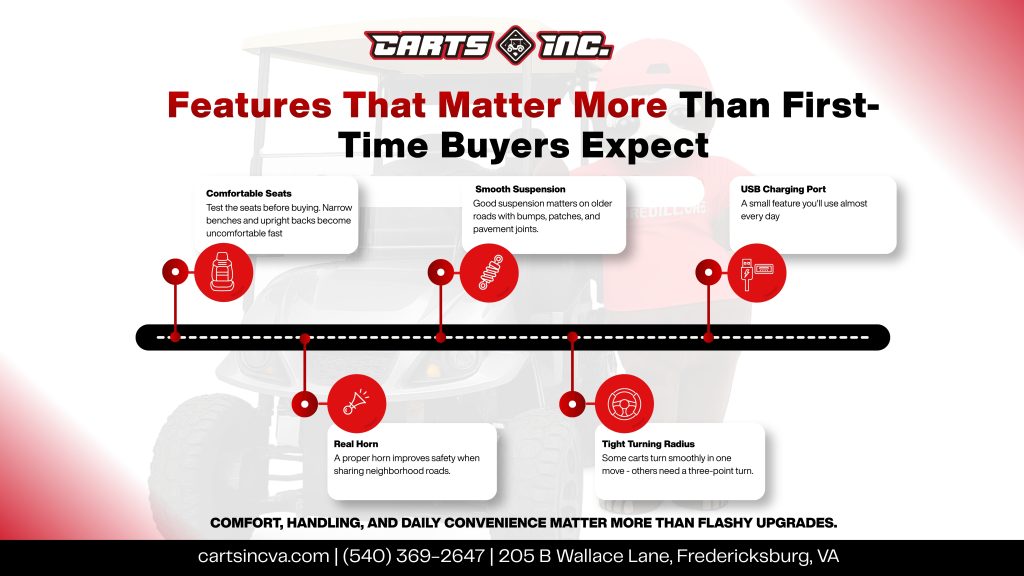
A few details that turn out to be important after you’ve owned the cart for six months:
- Seats that actually fit. Sit in the cart at the dealer. If the bench is too narrow or the back too vertical, you’ll regret it on every drive.
- Suspension matters more than most buyers think, especially on Fredericksburg’s older paved roads with patches and joints.
- A USB charging port is a small thing that gets used constantly.
- A real horn, not the original toy horn, makes a difference when you’re sharing the road.
- Turning radius. Some carts handle a residential cul-de-sac with one clean turn, others need a three-point.
Don’t Skip the Test Drive
Always drive the cart before you buy it. Even on a flat lot, you’ll feel things you can’t see. Brake response, steering tightness, ride comfort, motor noise, and how it accelerates from a stop all matter. If a dealer won’t let you drive it, that’s your sign to walk away.
Why Buy From a Local Virginia Golf Cart Dealer
You can buy a cart online and have it shipped. We see what happens when something breaks afterward. A local dealer with a service shop, a parts inventory, and a team you can actually call is worth the small price premium most of the time.
We’re based in Fredericksburg with a second spot in Urbanna, and we handle service for almost every brand we sell. Our VIP Program also adds free pickup and delivery for warranty work, which is a nice safety net.
Quick Buying Checklist Before You Sign Anything
Make sure you can answer yes to these:
- Do I know my realistic daily and weekly mileage?
- Have I decided on gas or electric?
- Do I know whether I need lithium or lead-acid?
- Have I checked my local ordinance to confirm I can legally drive it on the road?
- Have I test-driven the exact cart I’m buying?
- Do I have a written quote with all fees included?
- Is there a warranty? I understand.
If all seven are yes, you’re ready.
Contact Carts Inc. in Fredericksburg
Frequently Asked Questions
For most Virginia neighborhood buyers, a new or lightly used electric four-seater with lithium batteries hits the sweet spot. It’s quiet, has enough range for normal use, requires almost no maintenance, and resells well. Plan for around $13,000 to $17,000 for a solid mid-range model.
Lead-acid battery packs typically last 4 to 6 years with proper care, including monthly water checks. Lithium packs last 8 to 12 years and need almost no maintenance. Battery life depends heavily on how often you charge, how deeply you discharge, and whether the cart sits unused for long periods.
Both make sense in different situations. New gets you full warranty coverage and the latest features. Used can save you 30 to 60 percent on a similar model. The deciding factor is usually how long you plan to keep the cart and how much warranty peace of mind matters to you.
Yes. Most dealers, including us, offer financing terms of 36 to 60 months with reasonable rates. Approval is usually quick and doesn’t require the level of paperwork a car loan does. Putting 10 to 20 percent down keeps the monthly payment manageable.
A lead-acid pack typically needs 8 to 10 hours to fully recharge from empty. A lithium pack with a fast charger can recover in 4 to 6 hours, sometimes less. Most owners plug in overnight and never think about it.