


In 2026, a golf cart in Virginia typically runs between about $4,000 and $23,000, and where you land depends on new versus used, battery type, seat count, and whether the cart is a basic ordinance cart or a DMV-registered street-legal LSV. A clean, used four-seater sits around $6,000 to $9,000. A new personal four-seater with lithium runs roughly $11,000 to $15,000. A new street-legal LSV built for public roads usually starts around $14,000 and climbs past $18,000 with options. Those are honest ranges we quote here in Fredericksburg every week, and the sections below explain what pushes a cart to the top or bottom of each band.
What Drives The Number Before You Shop
Most price guides throw one big range at you and stop. That is not much help when you are trying to decide between a $6,000 used cart and a $15,000 new one. Below, we break the cost into the four levers that actually move the price on our lot: new versus used, battery chemistry, seating and build, and the single most Virginia-specific factor most guides skip entirely, whether you buy a plain ordinance cart or a titled LSV. We also lay out real price bands for each and where the hidden add-ons are. By the end, you will know roughly what your cart should cost before you ever call a dealer.
New Golf Cart Prices In Virginia: What The Bands Look Like
A brand-new cart is where the widest spread lives. The frame, the brand, the battery, and the seat count all stack on top of each other.
Here is how new pricing breaks down across the brands we carry (E-Z-GO, Madjax, Denago, and Evolution’s Maverick line) and what the wider 2026 market looks like:
| New cart type | Typical 2026 price | What you get |
| Budget two-seater, lead-acid | $5,000 to $8,000 | Neighborhood cart, basic trim, no frills |
| Personal four-seater, lead-acid | $8,000 to $12,000 | Family cart, common lift, and wheel packages |
| Four-seater with lithium | $11,000 to $15,000 | Longer range, lighter, near-zero battery upkeep |
| Six-seater or premium build | $14,000 to $23,000 | Big-family hauler, upgraded seats and trim |
| Street-legal LSV (new) | $14,000 to $18,000+ | Titled, plated, road-equipped from the factory |
The golf cart cost Virginia buyers ask us about most often is the middle tier, a new four-seater a family can actually use around the neighborhood. Plan on roughly $9,000 to $13,000 for a solid lead-acid build, and a bit more once lithium enters the picture.
One honest note. Sticker price is rarely the out-the-door number. A lift kit, larger wheels, a rear seat kit, a cooler rack, and a windshield can add $800 to $2,500 fast. We would rather tell you that up front than surprise you at delivery.
How the brands we carry stack up on price
Brand choice moves the number as much as seat count does. Here is the rough shape of it across the lines we stock, based on what these carts sell for new in 2026:
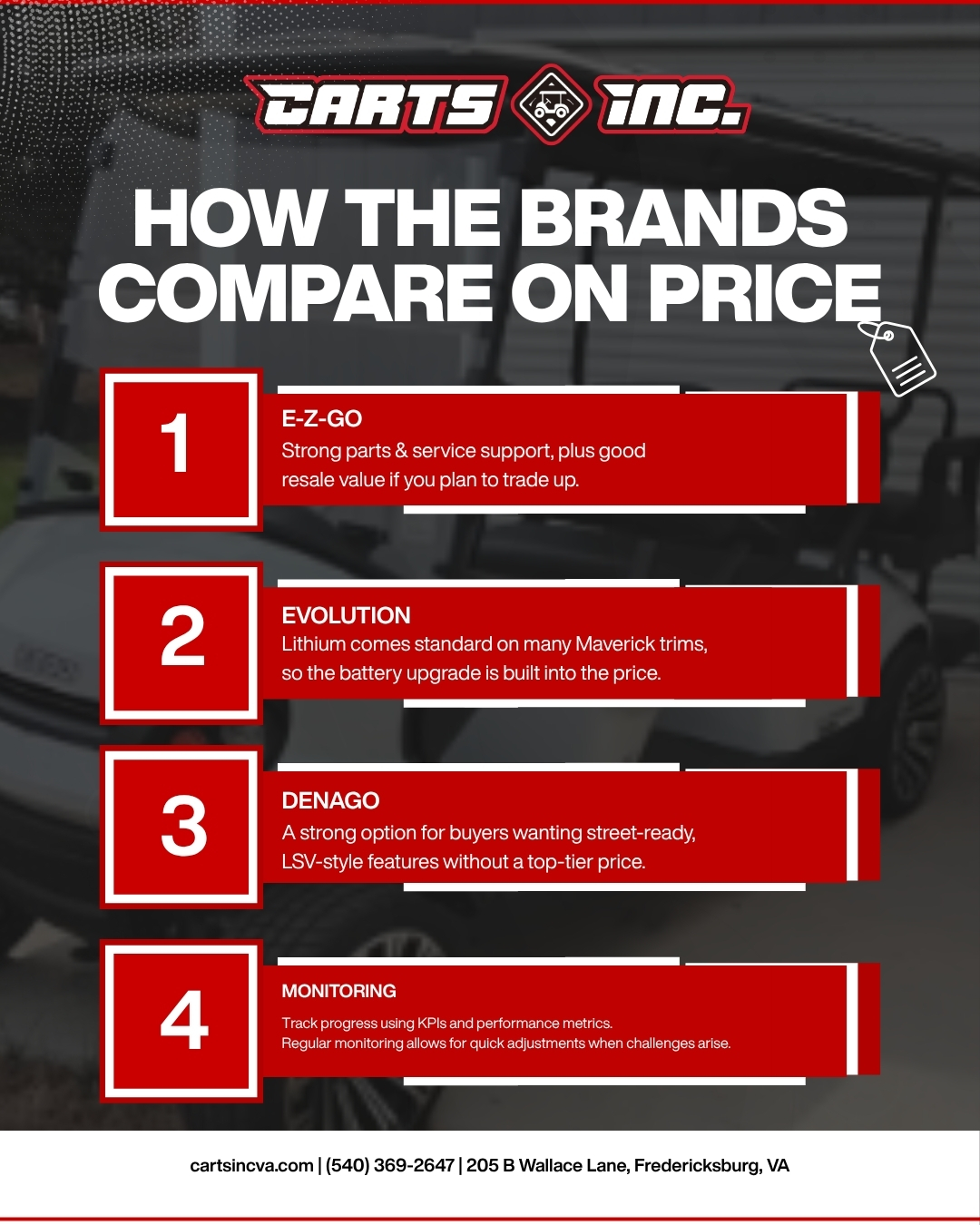
- E-Z-GO is a legacy name with strong parts and service support. New builds tend to sit in the middle-to-upper part of the new-cart bands above, and they hold resale value well, which matters if you ever trade up.
- Evolution’s Maverick line brings modern styling with lithium standard on many trims. The sticker looks higher, but you are buying the battery upgrade into the price rather than adding it later.
- Denago is positioned as a value-forward, street-ready line, often a strong pick for buyers who want LSV-style features without the top-tier sticker.
- Madjax is known more for the accessories and lift kits that personalize a cart, so it shows up as much in your options budget as in the base price.
The point is that two carts with the same seat count can differ by thousands based only on brand and how much of the build is baked in versus bolted on later. When you browse our new golf carts for sale, compare what is already included, not just the number on the tag.
Used Golf Cart Prices: Where The Real Value Lives
Used is where a smart Virginia buyer stretches a budget the furthest. The market runs wide because condition and battery age swing the value hard.
- A project or older cart, roughly 8-plus years, runs about $1,500 to $2,500. Expect tired batteries and cosmetic wear.
- A solid used cart, 4 to 7 years old, runs about $2,500 to $5,000, a common sweet spot for a first cart.
- Late-model used carts, 1 to 3 years old, run about $5,000 to $8,000, sometimes higher with lithium.
Here is the practitioner’s catch on used carts, and it is specific to how we buy and recondition here. The battery pack is the hidden half of the price. A used cart listed at $4,000 with a lead-acid pack on its last year can cost you another $1,000 to $1,500 in batteries within months, which quietly makes it a $5,500 cart. When we inspect a trade-in, the battery date codes and a load test matter more than the paint. Ask any seller how old the pack is and whether it has been load tested. If they cannot answer, treat the batteries as due for replacement and budget for it.
That single check is the difference between a used cart that is a genuine deal and one that just looks cheap on the tag. Our reconditioned used golf carts for sale get that battery inspection before they ever hit the lot, which is part of why we can stand behind the price.
Lithium Versus Lead-Acid: What The Upgrade Really Costs
Battery chemistry is the second-biggest price lever after new-versus-used, and it is worth understanding before you compare two carts.
A full lead-acid pack for a 36V or 48V cart runs about $800 to $1,500 and typically lasts two to three years under regular use. Lithium adds roughly $1,500 to $4,000 to the price of a cart up front, depending on pack size and voltage. For that premium, you get a pack that lasts far longer, charges faster, drops a lot of weight, and needs almost no maintenance.
The math usually breaks even somewhere around the three-to-five-year mark, sooner if you drive daily. If you plan to keep the cart a long time or run it hard, lithium is the better lifetime value, even though the golf cart prices Virginia shoppers see on lithium models look higher at first glance. If it is a light-use weekend cart you may replace in a few years, a good lead-acid pack is nothing to apologize for.
One thing we tell every buyer: do not judge a lithium cart purely on its higher sticker. Compare the pack you would otherwise replace twice.
The Virginia Factor: Ordinance Cart Versus DMV-Registered LSV
This is the cost driver almost every national price guide leaves out, and it is the one that matters most for what you can actually do with your cart on Virginia roads.
Virginia treats these as two different vehicles, and the choice changes both the price and the paperwork:
- Standard (ordinance) golf cart: Under state law, a plain golf cart is exempt from DMV titling, plates, decals, and registration fees. You can only drive it on public roads where your local governing body has passed an ordinance allowing it, and the town may require its own permit or decal. The upside is a lower total cost, no title fees, no annual registration, and no state insurance requirement.
- Low-speed vehicle (LSV): An LSV is titled, registered, plated, and insured through the Virginia DMV, and it can run on roads posted up to 35 mph. It ships from the factory with headlights, turn signals, mirrors, seat belts, a windshield, and a VIN. That road-ready build is why a new LSV starts around $14,000 and climbs past $18,000, plus title and plate fees and an annual insurance premium.
The real Virginia question is which road access you need. A neighborhood-only cart can be a far cheaper ordinance cart. If you want to legally run posted roads, you are buying into the LSV price tier and the DMV costs that come with it. For the full rules on that, our guide on whether golf carts are street legal in Virginia walks through the equipment and ordinance requirements in detail.
We see this decision trip up buyers more than any other. Someone falls in love with a $6,000 ordinance cart, then learns their town has no ordinance allowing carts on the road they wanted to drive, and now they are looking at LSV pricing instead. Sorting out road access first, then price, saves a lot of second-guessing. Central Virginia towns differ here, so what your neighbor across the county line can legally drive may not match your own street.
Turning a standard cart into a street-legal setup
If you already own an ordinance cart and want the road-legal look, a street-legal light and equipment kit runs about $300 to $800 for the parts, plus $150 to $400 in labor if a shop installs it. That gets you the lighting, mirrors, and signals. It does not, on its own, make a plain cart titled LSV in the eyes of the DMV, so confirm which path you actually need before spending on parts.
Matching The Golf Cart Cost Virginia Buyers Face To How You Will Use It
Price only makes sense next to use. The cheapest cart that does not do what you need is expensive. Here is how we usually steer buyers by what they actually plan to do with the cart.
For a neighborhood and yard cart that never leaves private property or ordinance-approved streets, a used four-seater or a modest new lead-acid built in the $6,000 to $11,000 window is plenty. Spending on LSV money here is spending on road-legal features you will not use.
If you want to run errands and post roads legally, you are in LSV territory, so plan for the $14,000-plus tier and the DMV costs. This is where financing makes the most sense, since the jump from an ordinary cart is real.
For a hunting, farm, or utility cart, gas still has a following for range and quick refueling, and new gas builds tend to land around $11,000 to $14,000. Lithium is closing that gap fast, but for remote-property use without easy charging, gas can still pencil out.
Buyers who match the tier to the job rarely regret the spend. The ones who chase the lowest sticker without asking what the cart needs to do are the ones who trade it in within a year.
Financing And The Out-The-Door Total
Sticker is one thing, monthly payment is another. Plenty of our Fredericksburg customers finance rather than pay cash, especially on the new and LSV tiers, and spreading a $13,000 cart over a term often turns a stretch purchase into an easy monthly number.
When you build your budget, add these to the base price:
- Options and accessories such as a lift, wheels, seats, or an enclosure, roughly $800 to $2,500
- For an LSV, the DMV title, plates, and annual insurance
- Delivery, if you are outside our free-delivery zone
- A battery replacement reserve on any used lead-acid cart
We deliver free within a 50-mile radius of Fredericksburg for qualifying buyers, which quietly saves central-Virginia customers a real cost that out-of-area dealers pass along. If you want to see current numbers on a specific model, our inventory pages list live pricing, and you can talk terms directly when you contact our Fredericksburg team about financing.
Putting the numbers together
Once you know your road access, your battery preference, and new versus used, the price band picks itself. A neighborhood ordinance cart, a lithium family four-seater, and a road-legal LSV are three different budgets, and matching yours to the right one is the whole game.
Where to go from here
Golf cart prices in Virginia cover a lot of ground, from a $4,000 used runabout to a $15,000-plus street-legal LSV, and the right number for you comes down to new versus used, battery type, and whether you need a plain ordinance cart or a DMV-titled LSV. Get those three decisions right, and you will not overpay. When you are ready to match a real budget to a real cart, Cart Inc is happy to walk you through current inventory, honest pricing, and financing without the pressure. Stop by our Fredericksburg lot or reach out, and we will help you land on the cart that fits both your driveway and your budget.
Frequently Asked Questions
Golf cart prices in Virginia generally run from $4,000 to $23,000 in 2026. A used four-seater sits near $6,000 to $9,000, a new lithium four-seater around $11,000 to $15,000, and a new street-legal LSV starts near $14,000 and climbs with options.
Used golf cart prices in Virginia usually range from about $1,500 for an older project cart to $8,000 for a late-model unit. Always factor battery age into the golf cart cost Virginia sellers quote, since a tired lead-acid pack can add $1,000 to $1,500.
Lithium adds roughly $1,500 to $4,000 over lead-acid up front, but lasts far longer, charges faster, and needs almost no upkeep. It usually breaks even in three to five years, sooner with daily use, making it the better lifetime value for regular drivers.
A street-legal LSV is titled, registered, and insured through the Virginia DMV and ships road-equipped with lights, mirrors, and signals. That build pushes the price to around $14,000 and up, plus title, plate, and insurance costs that a plain ordinance cart avoids.
Beyond the sticker, budget for accessories like lifts and seats ($800 to $2,500), a battery replacement reserve on used lead-acid carts, and for an LSV, a DMV title, plates, and annual insurance. Delivery may also apply outside a local dealer’s free-delivery zone.