


The new versus used golf cart decision sounds simple from the outside. New costs more, used costs less, pick what you can afford. The math is more interesting than that.
Over a five-year ownership window, the real cost gap between new golf carts and used ones is usually smaller than buyers expect, and sometimes the used cart costs more in the end. We’ve seen this play out hundreds of times in our service department. Here’s what the actual numbers look like in 2026 for Virginia buyers.
The Two Carts in This New vs Used Golf Cart Comparison
To make this concrete, let’s compare two carts that a typical buyer would actually consider.
The New Option
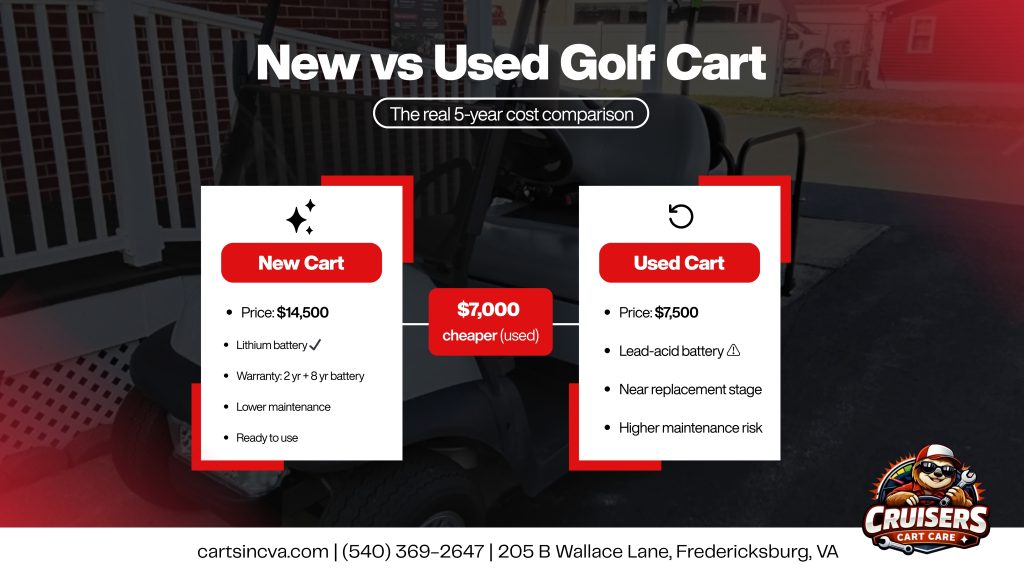
A new electric four-seater from a mid-tier brand with a lithium battery pack, a 2-year full warranty, and an 8-year lithium pack warranty. Out the door price: about $14,500 with basic street-legal equipment included.
The Used Option
A 4-year-old used an electric four-seater of similar build, with a lead-acid battery pack approaching the end of its useful life. Dealer-inspected price: about $7,500.
The starting gap is $7,000. That sounds like a huge win for the used cart. Let’s see what happens over five years.
Year-by-Year Cost Breakdown
Year 1
The new cart: zero unexpected costs. Maybe $80 for electricity if you drive a lot, plus a $50 routine check at the 1,000-mile mark.
The used cart: probably needs a new lead-acid battery pack within the first 12 months. Cost: $1,200 to $1,500 installed. Plus, maybe new tires if they were worn, around $400. Plus the same $80 in electricity.
Year 1 totals: New, about $130. Used, about $1,980.
Year 2
The new cart: still under full warranty. Maybe a $100 service visit and $80 in electricity.
The used cart: now running on its fresh battery pack. Normal service may be $200. Maybe a controller or charger issue, since these parts age. Budget another $300 just in case.
Year 2 totals: New, about $180. Used, about $580.
Year 3
The new cart: warranty starts winding down on parts other than the battery. Probably $250 in normal service.
The used cart: now 7 years old in real terms. Suspension parts and steering components often start needing work in this range. Budget $500 to $700.
Year 3 totals: New, about $250. Used, about $700.
Year 4
The new cart: 4 years old, still solid. Routine service plus possibly a controller or charger. Budget $400.
The used cart: now 8 years old. Lead-acid pack from year 1 is now approaching the end of life again. Add suspension wear, motor brushes, and general aging. Budget $900 to $1,200.
Year 4 totals: New, about $400. Used, about $1,100.
Year 5
The new cart: 5 years old. The lithium pack is still going strong with another 3 to 7 years left. Maybe $300 in service.
The used cart: 9 years old and needing real attention. Second battery pack replacement is coming due, plus likely several other parts will be replaced. Budget $1,800.
Year 5 totals: New, about $300. Used, about $1,800.
Five-Year Totals
New cart: about $1,260 in ownership costs plus the $14,500 purchase. Total cost: $15,760.
Used cart: about $6,160 in ownership costs plus the $7,500 purchase. Total cost: $13,660.
The used cart still wins by about $2,100 over five years. But the gap is much smaller than the $7,000 it looked like on day one.
When You Decide Whether to Buy a New or Used Golf Cart for Sale
There are a few real things that the spreadsheet misses.
Resale Value
A 5-year-old new cart usually sells for $7,000 to $9,000. A 10-year-old used cart sells for $2,500 to $4,000. Once you factor in resale, the new cart’s true 5-year cost can drop another $5,000 or $6,000 on the back end. That alone can flip the comparison.
Downtime
When a used cart breaks, it sits in your garage waiting for parts. That happened to one of our customers seven times in a single summer with a cart bought from a private seller. A new cart under warranty gets fixed quickly and often at no cost.
Reliability for Daily Use
If you depend on the cart for getting to the clubhouse, driving the kids to the pool, or hauling stuff around the property, a used cart that quits at the wrong time is a real problem. New carts have fewer surprises.
The Hidden Used Cart
A used golf cart bought from a private seller without a real inspection can hide major problems. We’ve seen seemingly clean carts with cracked frames, water-damaged controllers, and worn-out motors that the seller wasn’t even aware of. Always buy used from a dealer that inspects what they sell.
When New Makes More Sense
You should learn new things if any of these apply:
- You plan to keep the cart for 7 years or more. The longer you keep it, the more the warranty and lithium pack pay off.
- You depend on it daily and can’t tolerate downtime.
- You want the latest battery, motor, and safety tech.
- You’d rather not deal with surprise repairs.
- Your budget can stretch to $13,000 to $18,000 without strain.
When the Used Golf Cart vs New Option Wins
You should lean on if any of these apply:
- You plan to keep the cart for 3 years or less and resell. Used has less depreciation.
- You’re a hands-on owner who’s comfortable doing some of your own work.
- You want a cart for occasional use, not daily transportation.
- Your budget tops out around $8,000 to $10,000.
- You’re buying through a dealer that inspects used carts and offers some warranty coverage.
The Used Cart Buying Rules
If you go used, three rules keep most buyers out of trouble.
- Always buy from a dealer who inspects every cart before selling it. We do this on every pre-owned golf cart we list, and it eliminates the worst-case scenarios.
- Always test the battery pack under load, not just at rest. A weak pack will pass a quick voltage check and fail two weeks later.
- Consider our VIP Program. VIP members get free warranty pickup and delivery, which is especially useful for older carts that need more service.
A Quick Word on Financing
Most buyers don’t pay cash for either option. New carts qualify for financing terms of 36 to 60 months, which puts a $14,500 cart at roughly $250 to $300 a month. Used carts often qualify for shorter terms, which can mean similar monthly payments to a new cart even though the price is lower. Run the actual monthly number before you assume new is out of reach.
Our Honest Recommendation
If you’re a daily user planning to keep the cart for the long haul, new is usually the better value once you factor in resale, downtime, and warranty. If you’re a weekend user with a tight budget and you’re buying from a dealer that backs up its used inventory, used can save you real money.
Most importantly, don’t buy a used cart from a stranger on Facebook without an inspection. That’s the single most expensive mistake we see new owners make. Stop by either our Fredericksburg or Urbanna location, and we’ll walk you through both options side by side.
Contact Carts Inc. in Fredericksburg
Frequently Asked Questions
Both can be smart choices. New makes more sense if you’ll keep the cart 7 years or longer, or if you depend on it daily. Used makes more sense if your budget is tight and you’re buying from a dealer that inspects used carts. The 5-year total cost is often closer than the sticker prices suggest.
A new entry-level four-seater electric cart with lead-acid batteries starts around $11,000. A mid-range new electric four-seater with lithium batteries runs $14,000 to $19,000. Premium street-legal carts and LSVs can hit $20,000 to $28,000.
A dealer-inspected used four-seater electric cart typically runs $7,000 to $12,000, depending on age, condition, and battery pack. Two-seaters and older carts can be found for $4,000 to $7,000. Private-seller pricing varies wildly and carries more risk.
Lead-acid pack replacement runs $1,200 to $1,800 installed, depending on the cart. Lithium pack replacement is more, usually $2,500 to $4,500, but lithium packs last roughly twice as long.
It depends on the dealer. Reputable dealers usually include a limited warranty on used carts, often 30 to 90 days on major components. Private sellers offer no warranty at all, which is one of the biggest reasons to buy used through a dealer.